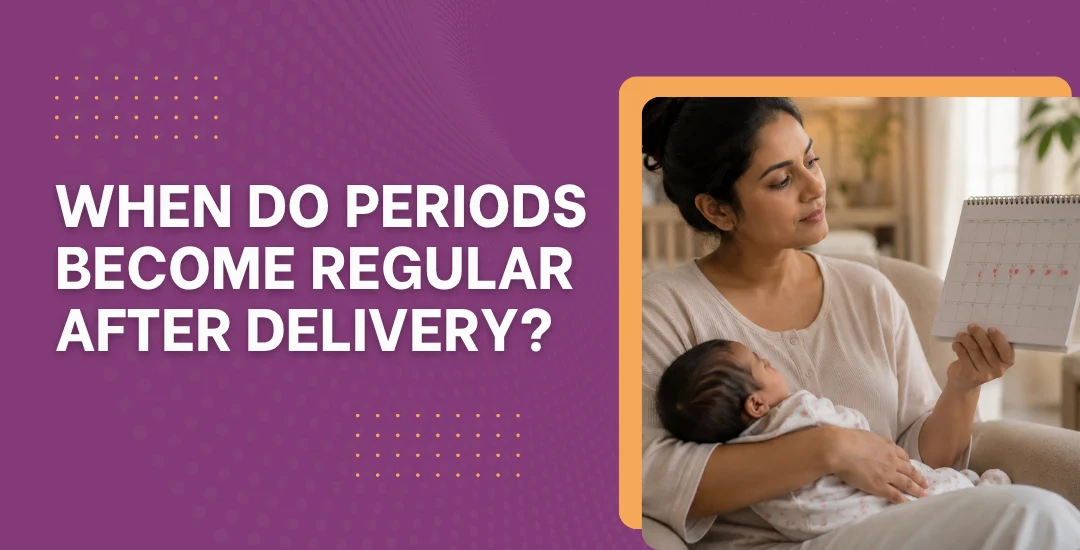
Your period typically takes a few months to settle into a rhythm once it returns, and honestly, the exact timeline comes down mostly to breastfeeding. For those not breastfeeding, cycles often stabilize within about 3 months. For breastfeeding mothers, regular periods might not show up until weaning starts, or feeds get cut back significantly.
According to Dr. Bhoomika Jain, gynecologist in Marine Lines, Mumbai: “New mothers worry a lot about irregular periods after delivery, but this is one of the most normal things a postpartum body does. Prolactin from breastfeeding suppresses ovulation, sometimes for months. It’s not a problem to fix, it’s biology doing exactly what it’s supposed to.”
Why Periods Take Time to Return?
Breastfeeding delays ovulation. Prolactin, the hormone behind milk production, suppresses the hormones needed to trigger ovulation. The more frequently you nurse, the longer this suppression tends to last.
Non-breastfeeding mothers see periods sooner. Without prolactin in the picture, ovulation can resume within 6 to 8 weeks, and periods often follow shortly after, though the first few cycles may still be irregular.
Hormones take time rebalancing after pregnancy. Estrogen and progesterone don’t snap back to pre-pregnancy levels overnight. So even once a period returns, it can take a few cycles before things settle into a predictable pattern.
Every body’s timeline is different. Some women see a period within 6 weeks. Others wait a year or more while breastfeeding exclusively. Both can be completely normal.
For a detailed overview of how postpartum cycle irregularities are assessed and treated, refer to the menstrual disorder treatment page.
What Counts as Normal vs Worth Checking?
Irregular cycles for the first several months postpartum are expected. That’s not usually cause for concern on its own.
Very heavy bleeding needs attention. Soaking through a pad hourly, or periods lasting well past 7 days, go beyond typical postpartum adjustment and should get checked.
No period at all after a year of not breastfeeding is worth a visit. If cycles haven’t returned despite weaning or minimal feeding, something else might be going on hormonally.
Severe pain that wasn’t there before pregnancy is also worth mentioning at a follow-up, even if bleeding itself looks normal.
This earlier post on how much period bleeding is too heavy covers exactly where that line sits.
Why Choose Dr. Bhoomika Jain?
Dr. Bhoomika Jain is an Obstetrician, Gynaecologist, and IVF Specialist with over nine years of experience and a Fellowship in Assisted Reproductive Techniques from KEM Hospital, Mumbai. She has managed PCOD and PCOS across every stage, from teenagers to women planning a pregnancy.
Diagnosis comes first, confirmed through proper testing rather than assumed from symptoms. Treatment is then built around your body and your goal, whether that is regular cycles or conceiving. Every plan is specific to the patient.
Periods still irregular months after delivery?
FAQs
Can I get pregnant before my first postpartum period?
Yes. Ovulation happens before the period does, so it’s possible to conceive again even without a period showing up first.
Is it normal for the first period after delivery to be heavier than usual?
Fairly common, yes. The uterine lining is often thicker initially, so the first cycle or two can be heavier or longer than what’s typical for you.
Does pumping instead of direct breastfeeding change the timeline?
It can. What matters most is frequency and hormonal response, not the method, so exclusive pumping delays ovulation similarly to direct nursing.
Should periods be painful again after childbirth?
Some women notice less menstrual pain postpartum, others notice more. Both patterns happen, and neither is automatically abnormal on its own.
When should irregular postpartum periods trigger a doctor visit?
Past 3 months if not breastfeeding, or if bleeding is unusually heavy, prolonged, or accompanied by severe pain at any point.
References:
Disclaimer: This content is published for educational and informational purposes only.