
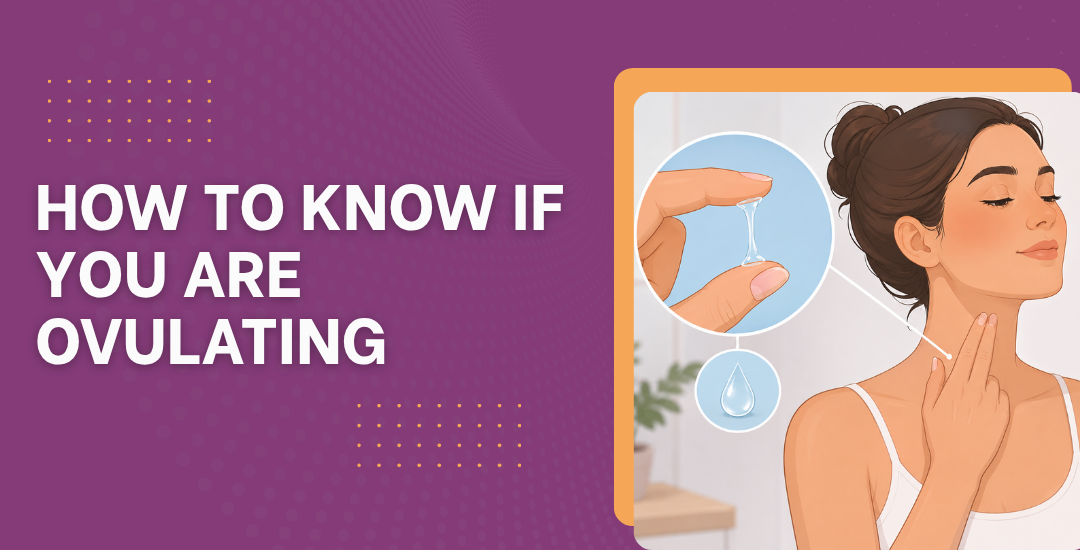
Your body drops a few hints. The clearest one is cervical mucus, around ovulation it turns clear and stretchy, a bit like raw egg white. Then there’s basal body temperature. It nudges up by half a degree or so the day after you ovulate, and stays up. Some women feel a dull ache on one side of the lower belly. Others notice a heightened sex drive, or tender breasts. In a typical 28-day cycle ovulation lands near day 14, but cycles aren’t textbooks. They shift. The most reliable way to be sure is tracking a couple of these signs together rather than betting on one.
According to Dr. Bhoomika Jain, a leading gynecologist in Marine Lines, “No single sign confirms ovulation on its own, but when the mucus changes and the temperature rises together, that’s usually a dependable window.”
What are the main signs of ovulation?
Your body shifts in small ways around this point. A few are easy to catch once you know what you’re after.
Mucus: The big tell. It goes clear, slippery, and stretchy right before ovulation, then turns thick and dries up after.
Temperature: A small rise the morning after you ovulate. You’ll only spot it by charting daily, but it’s a solid confirmation.
Pain: Some women get a one-sided twinge low in the belly. Mittelschmerz, it’s called. Brief, and not everyone feels it.
Drive: A natural uptick in libido around your fertile days. The body’s own nudge, basically.
Reading these signs matters most when you’re trying to conceive, and pairing them with proper infertility treatment helps if cycles are irregular.
How can you track ovulation accurately?
Signs are a start. For real precision, a few tools do the job better.
Kits: Ovulation predictor kits catch the LH hormone surge a day or so before you ovulate. Easy, and fairly accurate.
Charting: Logging your temperature every morning builds a pattern over a few cycles. Slow, but it shows your personal rhythm.
Ultrasound: Follicular scans track the egg as it matures. This is the most precise route, done at the clinic.
Apps: Handy for logging, but they only predict off averages, so don’t lean on them alone if cycles wander.
When ovulation isn’t happening on schedule, it’s worth understanding how PCOD affects natural pregnancy before planning the next step.
Why Choose Dr. Bhoomika Jain?
Dr. Bhoomika Jain is an Obstetrician, Gynaecologist, and IVF Specialist with over nine years of experience and a Fellowship in Assisted Reproductive Techniques from KEM Hospital, Mumbai. She has helped women identify their fertile window through cycle tracking and ultrasound monitoring and treated irregular cycles that complicate conception.
Ovulation is confirmed clinically, with follicular scans where needed, rather than estimated from an app. From there, you receive timed guidance built around your actual cycle and supported by accurate testing.
Trying to time things and the signals feel confusing?
FAQs
Q1: On which day do most women ovulate?
In a 28-day cycle, ovulation usually happens around day 14, but it varies.
Q2: Can you feel ovulation happening?
Some women feel a mild one-sided pelvic ache, though many feel nothing at all.
Q3: Are ovulation kits accurate?
Yes, they detect the hormone surge before ovulation and are fairly reliable for timing.
Q4: Can you ovulate without a period?
Rarely, but irregular or absent periods usually mean ovulation is not happening.