
Ask a room full of women how long their cycle is and you won’t hear 28 from everyone. For a healthy adult who isn’t on hormonal contraception, a normal menstrual cycle length runs anywhere from 21 to 35 days, and the textbook 28 is simply the middle. The average period cycle works out to about 28 days across a crowd, but individual women scatter all over that range, and that scatter is typical. Some guidelines, FIGO’s among them, push the upper edge to 38 days, so the cutoff you see depends on the source.
According to Dr. Bhoomika Jain, a gynecologist in Marine Lines, “Count from the first day of bleeding to the first day of the next, and watch your own pattern over a few months. A woman who runs 26 days every month is usually fine. Cycles that suddenly lurch by a week or more deserve a second look.”
How Do You Count Your Cycle, and What Length Is Healthy?
It takes a calendar and about a minute a month.
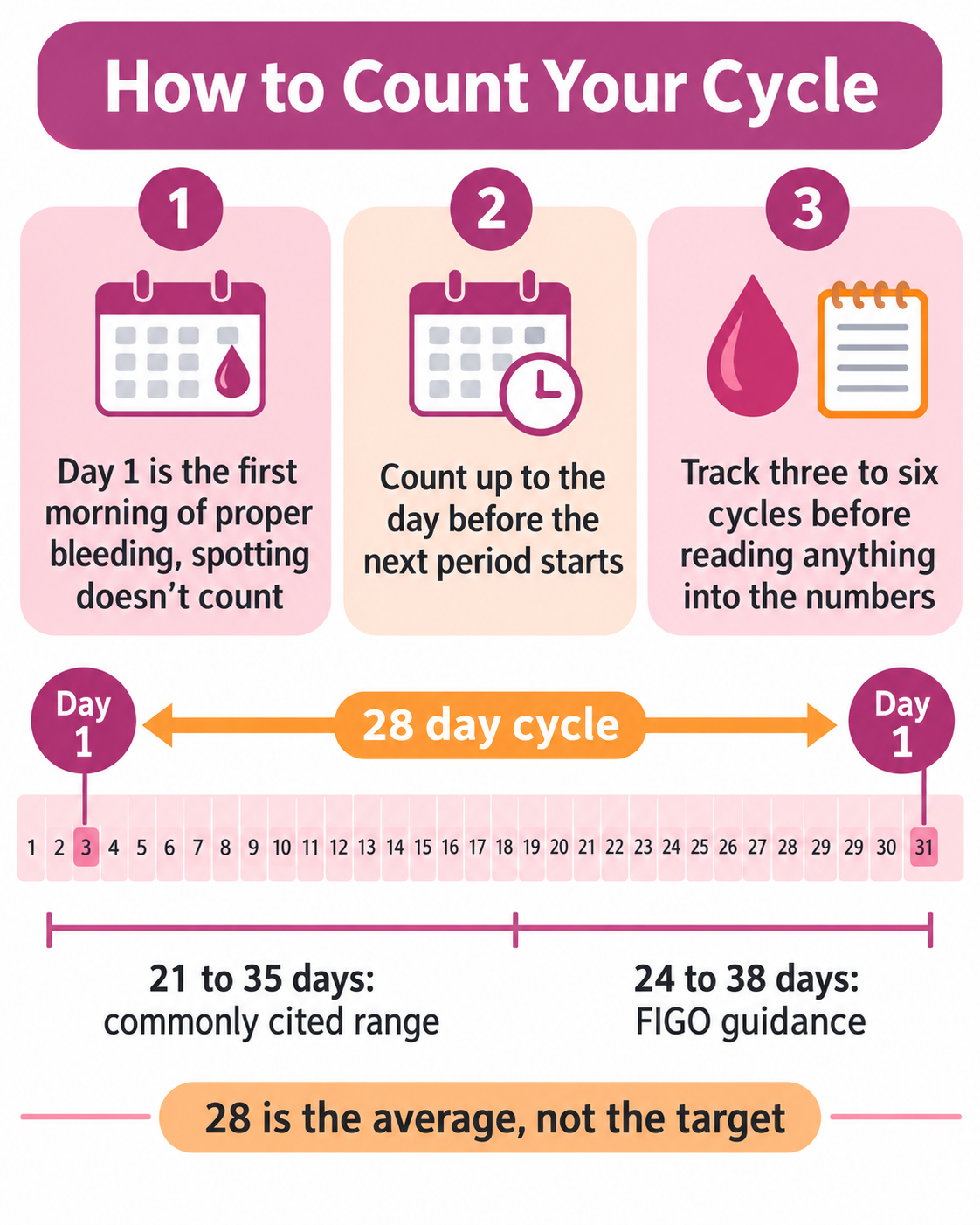
- Day one: Spotting doesn’t count. Day one is the first morning of proper bleeding, so circle it on a calendar or log it in an app.
- The count: Your cycle runs up to the day before the next period starts. Say a period began on the 3rd and the next one on the 31st. That cycle was 28 days.
- The healthy range: Most sources quote 21 to 35 days. FIGO’s guidance is a little wider, at 24 to 38. Land anywhere inside either range and you’re not running late or early.
- How long to track: Give it three to six cycles before you read anything into the numbers. A single odd month proves very little.
Cycles that keep landing outside that window are one of the concerns covered under menstrual disorder treatment.
Why Does Cycle Length Change From One Month to the Next?
A few days of drift is routine. The causes are usually everyday ones.
| Cycle length | What it usually means | Common reasons |
| Under 21 days | Frequent cycles | Ovulating early, an overactive thyroid, the run up to perimenopause |
| 21 to 35 days | Within the commonly cited range | Normal variation, with stress or travel nudging it by a few days |
| 36 to 38 days | Long, but inside FIGO limits | A slower cycle after illness, stress, or weight change |
| More than 38 days, say 40 | Infrequent cycles | PCOD, thyroid or prolactin trouble, hard training, pregnancy, breastfeeding |
- Stress and sleep: One brutal month at work, a long haul flight, a week of bad nights. Any of these can push ovulation back, and the period follows late. That’s often all it takes for 28 to become 35 for a cycle or two.
- Weight and exercise: Losing weight quickly, training hard, or eating far too little can stretch cycles. Putting on weight fast can do the same.
- Hormonal conditions: Cycles that stay long month after month often trace back to PCOD, a thyroid problem, or raised prolactin. A 21 day pattern that repeats can have a hormonal cause as well.
- Life stages: Teenagers, new mothers, and women in their 40s all tend to have cycles that wander. Perimenopause tends to shorten them first, then space them out.
Cycle changes with no obvious trigger are covered in this article on irregular periods.
When Is a Cycle Abnormal, and When Should You See a Doctor?
Cycle length tells only part of the story. How long you bleed, how much, and how steady it is count too.
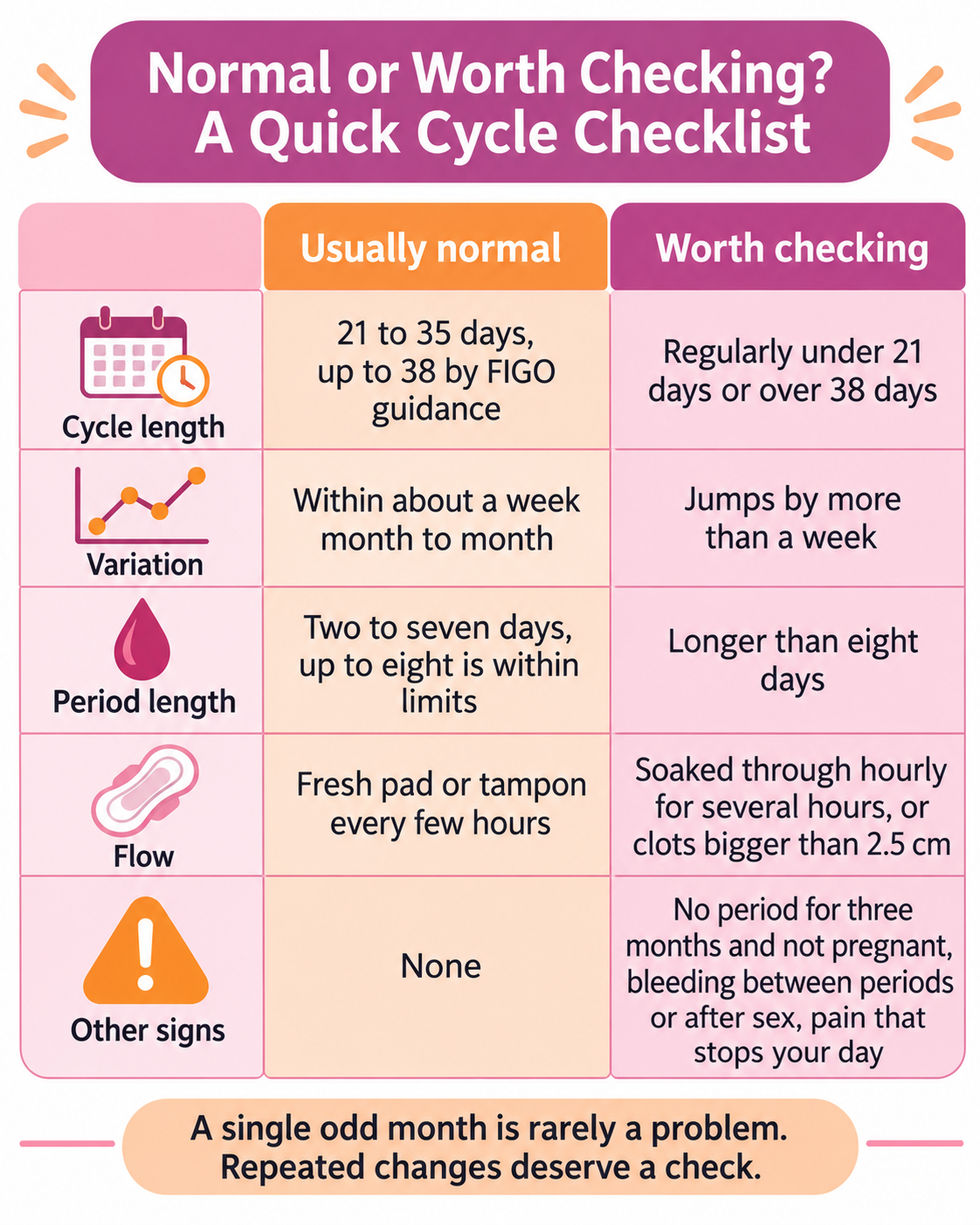
- Length and variation: A cycle that’s regularly under 21 days or over 35 to 38 deserves a look. So does one that jumps around by more than a week from month to month.
- Duration: Two to seven days is typical, and eight is still within limits. Beyond that, ask why.
- Flow: A normal period needs a fresh pad or tampon every few hours, not every hour. If one is soaked through hourly for several hours, or clots bigger than about 2.5 cm keep passing, that’s heavy bleeding.
- Red flags: Three months with no period and no pregnancy, bleeding between periods or after sex, or pain bad enough to stop your day. Get these checked.
If long gaps come with acne or weight gain, polycystic ovaries are a common explanation, and they’re explained under PCOD treatment.
Wondering whether your own cycle falls inside the normal range?
Key Takeaways: Most cycles fall between 21 and 35 days, guidelines allow up to 38, and 28 is only the average. Count from one day one to the next, log a few months, and get checked if you see repeated 40 day cycles, very short cycles, long or heavy periods, or sudden swings.
FAQs
Is a 40 day period cycle normal?
Not usually. Longer than 38 days counts as infrequent, and repeats deserve a check.
How do I count my cycle days?
Day one is proper bleeding. Count up to the day before the next.
Why has my cycle gone from 28 to 35 days?
Weight changes, illness, work pressure, or hormones can delay ovulation. Persistent changes need checking.
How do you lose belly fat with PCOD?
Exercise regularly, eat at steady times, and rest well. Crunches alone won’t help.
References:
This blog is for educational and informational purposes only and should not be considered professional advice.