
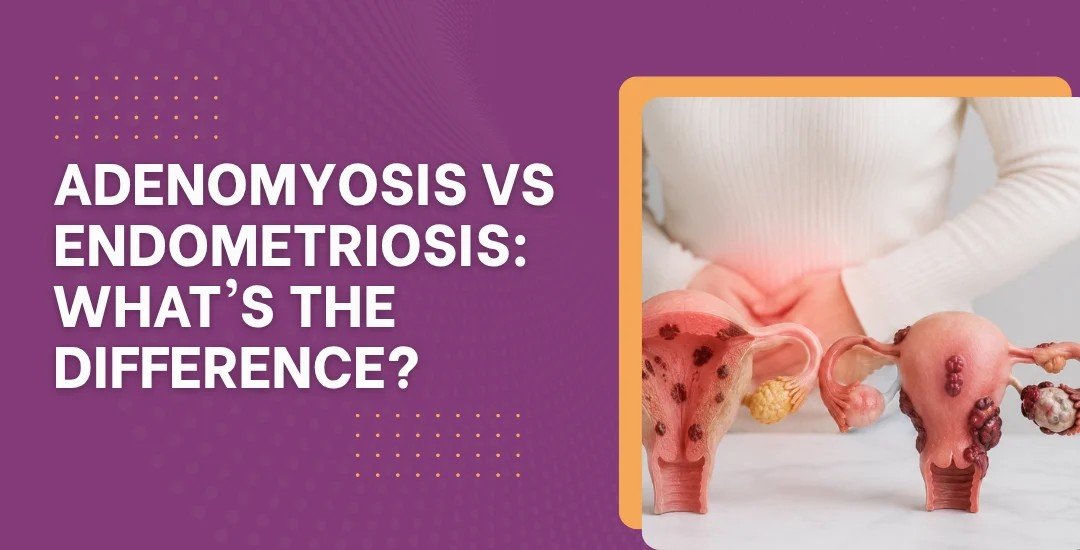
Both adenomyosis and endometriosis involve tissue that looks and behaves like the uterine lining, but where that tissue ends up is what actually separates them. In adenomyosis, it grows into the muscular wall of the uterus itself. In endometriosis, it shows up outside the uterus entirely, on the ovaries, pelvic lining, or nearby organs.
According to Dr. Bhoomika Jain, gynecologist in Marine Lines, Mumbai: “Patients confuse these two constantly, and honestly, the names don’t help. Similar tissue, similar symptoms even, but they’re happening in completely different places, and that difference changes how we approach treatment.”
Adenomyosis vs Endometriosis: Key Differences
Aspect | Adenomyosis | Endometriosis |
Where tissue grows | Inside the uterine muscle wall | Outside the uterus, on ovaries, pelvic lining, or other organs |
Typical age | Often 40s, especially after childbirth | Any reproductive age, sometimes diagnosed in teens |
Main symptom | Heavy, painful periods, enlarged uterus | Pelvic pain, painful periods, pain during intercourse |
Fertility impact | Can affect fertility, less directly studied | Strongly linked to infertility in many cases |
Diagnosis | Ultrasound or MRI, sometimes confirmed only after hysterectomy | Laparoscopy is the definitive diagnostic method |
Common treatment | Hormonal therapy, sometimes hysterectomy | Hormonal therapy, laparoscopic excision surgery |
The tissue origin is identical, but the location it grows into determines the diagnosis entirely. For a detailed overview of how both conditions are assessed and managed, refer to the gynecology services page.
What Actually Points to One or the Other?
Growth after menopause goes against what is expected. When it happens, it warrants a proper look, not a wait-and-see approach.
Growth after menopause is not the norm: Fibroids shrinking is the expected pattern. Any fibroid that continues growing once estrogen has dropped is worth investigating properly rather than monitoring casually.
New or worsening symptoms need attention: Pain, pressure, and especially any bleeding after menopause should not be happening at all, regardless of fibroid history. These are not things to observe and hope resolve.
Imaging clarifies what is actually happening: An ultrasound or MRI distinguishes between a fibroid that is simply slow to shrink and one that needs a much closer eye. Testing here is diagnostic, not precautionary.
Size alone is not always the trigger: Even a fibroid showing no dramatic growth but producing new symptoms after menopause deserves evaluation. Symptom change matters as much as size change when hormones are no longer in the picture.
For a broader overview of how fibroid treatment decisions are made, refer to this earlier post on whether fibroids always need surgery.
Why Choose Dr. Bhoomika Jain?
Dr. Bhoomika Jain has spent over nine years focused on obstetrics, gynecology, and reproductive health. Her Fellowship in Assisted Reproductive Techniques from KEM Hospital, Mumbai, shapes her approach, hormones first, symptoms second. She doesn’t apply a single label to chronic pelvic pain without working through what is actually driving it. Adenomyosis and endometriosis require different treatment paths, and that distinction gets established properly before any plan is built. Patients get a doctor who investigates the cause rather than managing the symptom.
Both conditions present differently on every patient, and they overlap often enough that a careful diagnostic approach matters more than a quick answer. Imaging, symptom history, and laparoscopy where indicated are used together rather than in isolation. For women who have been managing pain for years without a clear diagnosis, getting the distinction right is usually where things finally start to shift.
Not sure whether your symptoms point to adenomyosis or endometriosis?
FAQs
Can I have both adenomyosis and endometriosis at once?
Yes, and it happens more often than most people realize. The two aren’t mutually exclusive, and having one doesn’t rule out the other.
Which one is more likely to cause infertility?
Endometriosis has a stronger, better-documented link to infertility. Adenomyosis can affect fertility too, but the connection isn’t as clearly established.
Does adenomyosis always require a hysterectomy?
No. Hormonal treatment manages many cases well. Hysterectomy usually comes up only when symptoms are severe and other options haven’t worked.
Is laparoscopy always needed to diagnose endometriosis?
It’s the definitive method, yes, though imaging and symptom history can strongly suggest it beforehand without surgery.
Are the symptoms of both conditions treated the same way?
Overlapping, but not identical. Hormonal therapy helps both, though surgical approaches differ significantly between the two conditions.
References:
Disclaimer: This blog is for general educational purposes only and is not a substitute for professional medical advice; please consult your doctor for personal care.